
Founding product design · Nov 2023 — May 2024
From travel inspiration to a confident next move.
Daze began as an early recommendation-product concept for people deciding what to do while already at a destination. I worked with the founder to narrow the direction, then independently translated the core experience into a high-fidelity mobile prototype.
- Role
- Founding Product Designer
- Stage
- Early product · MVP exploration
- Worked with
- Founder
- Scope
- Direction · IA · flows · prototype
The product question
People did not need another endless travel feed.
The opportunity was to help someone move from “What could I do?” to “This is what I want to do next.” The first version therefore needed a clear decision journey—not a larger catalogue of places to browse.
01 · Product direction
Turn an open-ended idea into a bounded MVP.
I worked with the founder to make the early concept concrete: what the product should help people decide, what information it needed first, and which moments belonged in the initial journey. That direction became an information architecture connecting onboarding, preference capture, contextual recommendations, and the next decision.
My contribution — Product framing with the founder; information architecture and core flows designed independently.
02 · Experience model
Design for a decision, not for more browsing.
Learn enough
Use onboarding and preferences to establish useful context without making setup the product.
Surface relevance
Organize the main experience around contextual recommendations rather than an undifferentiated destination list.
Support the next move
Give each recommendation enough structure for someone to evaluate it and continue with confidence.
03 · Making it tangible
A prototype the team could see, navigate, and challenge.
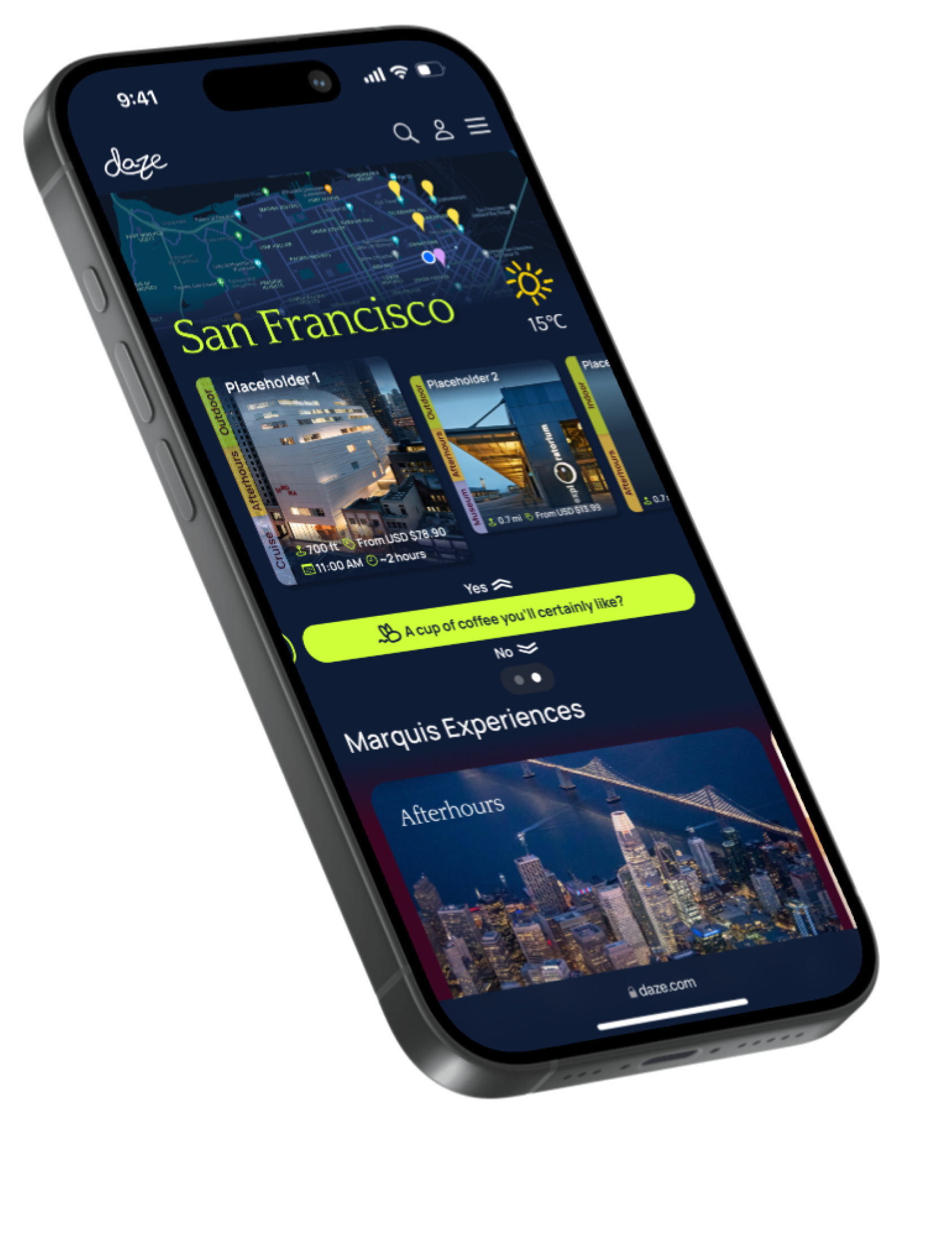
I independently designed the high-fidelity onboarding, recommendation flow, and preference settings, then connected them into an end-to-end prototype. The prototype turned an ambiguous concept into a concrete product direction that could be reviewed and refined with the founder.
Prototype-stage exploration; no launch or business outcome is claimed.
What this work demonstrates
Early products need a coherent decision model before they need more screens.
Framing under ambiguity
Narrowing a broad concept into a discussable MVP direction.
Journey-level product design
Connecting structure, onboarding, preferences, and recommendations.
Prototyping as product thinking
Using a high-fidelity experience to make decisions visible.